American Football Running Back: Evaluating a Continuous Line Drawing Set for Creative Projects
When you need visual assets that capture motion, power, and precision, few subjects compare to the American football running back. The position demands a unique blend of speed, vision, and physical toughness—qualities that translate well into minimalist art. A continuous line drawing set featuring running backs, wide receivers, quarterbacks, and tight ends offers a distinctive way to bring that energy into your work. But is this kind of asset set worth adding to your library? Let's examine its design, usability, and practical value across real-world creative applications.
What the American Football Running Back Illustration Set Includes
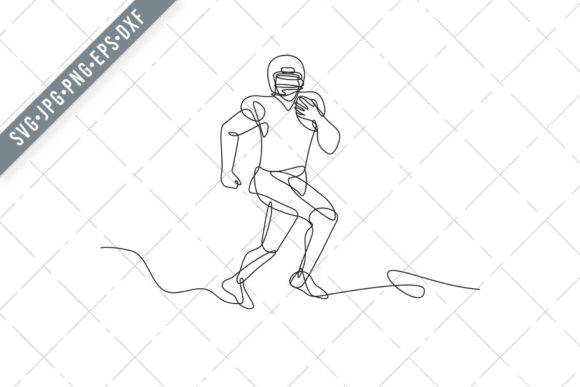
This particular collection focuses on continuous line drawings of key offensive positions, with the running back as the central figure. The set provides multiple file formats so you can use the artwork across different software and hardware environments. You receive an SVG vector file compatible with Silhouette Studio Cameo, Cricut, and other cutting machines, along with a high-resolution PNG at 300 dpi and a minimum size of 10 inches. DXF, EPS, and JPG files round out the package, giving you flexibility whether you work in Adobe Illustrator, CorelDRAW, Affinity Designer, or a web-based design tool.
The continuous line style is worth noting. Each illustration is drawn in a single, unbroken stroke, which creates a fluid, sketch-like appearance. This approach strips the subject down to essential contours, emphasizing posture, stride, and ball placement without the noise of shading or color gradients. For the running back specifically, that means the forward lean, the arm carrying the ball, and the driving leg movement become the focal points.
Key Characteristics of the Continuous Line Style
Continuous line drawing has a long history in fine art, but its application in commercial design is relatively underserved. What makes it effective here is how well it matches the subject. The running back's motion is directional and explosive, and a single line can suggest momentum better than a highly detailed rendering. The style also leaves visual breathing room, which matters when you integrate the artwork into larger compositions like banners, patterns, or card layouts.
The set covers multiple positions—running back, wide receiver, quarterback, and tight end—so you are not locked into one pose or player type. If you are designing a series of T-shirts or a set of greeting cards, having variety within the same visual language keeps the collection cohesive. The line weight appears consistent across the drawings, which suggests the vector files were cleaned and optimized before export. That consistency saves you time because you won't need to manually adjust stroke thickness across different files.
Real-World Performance and Usability
When you download a design set, the real test is how it behaves when you open it in your software and start editing. The SVG files in this set open cleanly in vector editors like Adobe Illustrator, Inkscape, and Affinity Designer. The paths are closed where they need to be, so you can fill the interior of the figure with color if you want to invert the look or create a solid silhouette version. For cutting machine users, the SVG imports directly into Silhouette Studio and Cricut Design Space without missing nodes or broken paths—a common frustration with poorly prepared vector files.
The PNG files at 300 dpi and 10 inches give you a ready-to-use raster option. That resolution works for print-on-demand products like mugs, stencils, and wall art up to about 16 by 20 inches before you start noticing pixelation. If you need larger output for banners or posters, the vector files let you scale indefinitely without quality loss. The EPS files are useful if you work in legacy software or need to place the artwork into QuarkXPress or older versions of CorelDRAW. The JPG files serve as quick previews or low-resolution placeholders during layout planning.
Flexibility Across Project Types
This set is designed to be multi-purpose, and that claim holds up across several common use cases:
- T-shirts and apparel: The continuous line style works well for screen printing because it uses solid strokes without fine detail that might break up during the transfer process. You can scale the running back figure to fit a chest print or enlarge it for a back design.
- Mugs and drinkware: The minimalist aesthetic fits nicely on curved surfaces where complex details can get lost. A single continuous line drawing reads clearly on a ceramic mug.
- Stencils: Because the line is continuous and the interior areas are accessible, you can easily convert the SVG into a cut stencil for paint or etching. This is a practical application that many design sets do not support well.
- Greeting cards and invitations: The sketch-like quality adds a handmade feel to printed materials without requiring you to draw anything yourself. This can be useful for sports-themed party invitations or thank-you notes.
- Wall art and posters: At larger sizes, the single line becomes a bold decorative element. A framed print of a running back in this style works in a home office, gym, or game room.
- Patterns and scrapbooking: You can repeat the SVG elements to create custom wallpaper, wrapping paper, or digital backgrounds. The line style remains readable even when tiled.
Who Benefits Most from This Set
Not every designer or creator will find this asset equally useful. Understanding the target audience helps you decide whether it fits your workflow.
Freelance graphic designers and small business owners who take on sports-related projects will get the most immediate value. If a client needs a quick set of football-themed graphics for a youth league fundraiser, a camp, or a team store, having these files ready to customize saves hours of drawing time. The multiple file formats also mean you can deliver final artwork in whatever format your client requires without re-exporting from scratch.
Print-on-demand sellers benefit from the vector format because they can upload SVG files directly to platforms like Printful, Printify, or Redbubble. The continuous line style is currently popular in POD marketplaces, so it aligns well with trending aesthetics. You can also modify the line color, add text, or combine multiple figures from the set to create original compositions.
Hobbyists and crafters using cutting machines will appreciate that the files work out of the box. You do not need to trace or clean up imported images. Load the SVG into your software, size it, and cut. For vinyl projects, the continuous line design weeding is straightforward because there are no tiny isolated islands of material.
Educators and content creators might use these illustrations for worksheets, presentations, or social media graphics. The line style reads well at small sizes, which is important for mobile screens and slides projected in a classroom.
Strengths and Potential Limitations
On the strength side, the file format variety is a genuine advantage. Many illustration sets only provide PNGs or a single vector format. Having SVG, DXF, EPS, and JPG alongside a high-res PNG means you are covered for almost any production pipeline. The 300 dpi PNG at 10 inches is also a meaningful specification because lower-resolution assets often fail for print projects.
The continuous line style itself is a strength if your project calls for a modern, minimal, or hand-drawn look. It pairs well with bold typography, negative space layouts, and monochrome color schemes. It also avoids the dated appearance of overly detailed clip art.
However, there are limitations worth noting. The continuous line approach means the drawings are stylized rather than anatomically precise. If your project requires realistic depictions of a running back's form or equipment details, these illustrations will not satisfy that need. The simplification is intentional, but it is not a fit for every use case.
Also, the set covers only offensive positions. If you need defensive players, linemen, or special teams illustrations, you would need to look elsewhere. The selection is focused, which is fine for targeted projects, but it limits the set's utility for comprehensive team or league materials.
Finally, the files are provided as-is. There are no editable text layers, no color variations included, and no accompanying fonts. You are getting the raw illustrations, which is appropriate for an asset pack, but you should factor in the time needed to customize colors and combine elements if your project requires that.
Practical Recommendations for Buyers
Before purchasing this set, consider your specific project needs. If you are designing for a single event or a small run of products, the variety of formats and the ready-to-cut SVG files will likely save you more time than the cost of the set. If you are building a long-term library of sports graphics, this set can serve as a base that you expand with complementary assets.
For T-shirt designers, test the line thickness on your chosen garment color. A white line on a dark shirt often reads differently than a dark line on a light shirt. Because the SVG is fully editable, you can adjust stroke weight and color to suit your substrate. For stencil makers, the open interior of the running back figure means you can cut a stencil that preserves the continuous line as a negative space or as a positive stroke, depending on your preference.
If you work with print-on-demand platforms that require specific file types—some accept SVG uploads, others prefer PNG with transparent backgrounds—you have both options here. That flexibility reduces the friction between concept and listing.
Long-Term Value and Consistency
An illustration set like this has good long-term value if you regularly produce sports-themed content. The continuous line style is not trend-driven in a way that will look dated in a few years. Minimal line art has been used in commercial design for decades and continues to appear in branding, apparel, and home decor. The vector format also means you can revisit the files years later and still edit them at any resolution or scale.
The consistency across the four positions—running back, wide receiver, quarterback, and tight end—means you can mix and match them in a single design without visual conflict. That is harder to achieve with assets from different sources that may have different line weights, drawing styles, or proportions. Having a unified set simplifies layout decisions and keeps the final product looking polished.
Final Observations on Fit and Usefulness
This continuous line drawing set delivers what it promises: clean, editable vector illustrations of American football offensive positions in a minimalist style. The running back figure anchors the collection, and the additional positions give you enough variety for most sports design projects. The file format support is comprehensive, and the resolution specifications meet professional print standards.
Where the set falls short is in scope. It is a focused tool, not a comprehensive library. If you need a full roster of positions or highly detailed, realistic artwork, you will need supplementary resources. But for its intended purpose—providing ready-to-use, scalable line art for apparel, print, and craft projects—it performs reliably.
For freelancers, small business owners, print-on-demand sellers, and crafters who need football-themed designs without starting from scratch, this set offers practical value. The time saved on drawing and vectorizing alone can justify the investment, especially when you consider the variety of output formats. Just match the style to your project's tone, and you will have a functional asset that supports your creative work from concept to finished product.