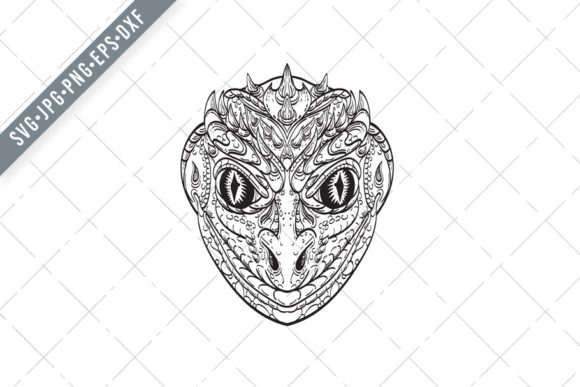
Head of a Reptilian Humanoid Alien SVG
If you’ve stumbled upon a Head of a Reptilian Humanoid Alien SVG while searching for unique design elements, you’re likely drawn to the blend of mythology, tattoo aesthetics, and clean vector art. This specific style—a monoline line art drawing of a reptilian humanoid, reminiscent of legendary creatures that are part human, part lizard—has gained traction among crafters, small business owners, and digital creators. But before you download, buy, or use one of these SVG files, there are practical considerations that can save you time, frustration, and wasted materials.
Many people treat SVGs as a one-size-fits-all solution, but the Head of a Reptilian Humanoid Alien SVG is more nuanced than a generic clip art. The file set typically includes SVG, PNG, DXF, EPS, and JPG formats, each serving a different purpose. Understanding these distinctions and common missteps will help you get professional-looking results without guesswork.
Mistake #1: Assuming All File Formats Are Interchangeable
One of the most frequent oversights is thinking that the SVG, PNG, DXF, EPS, and JPG files are identical in use. They are not. The SVG vector file is designed for cutting machines like Silhouette Cameo and Cricut, but only if your software properly handles vector paths. The PNG at 300 DPI is for print or web use where transparency matters. The DXF is for CAD-like software, and EPS works in professional design apps like Adobe Illustrator. The JPG is a fallback for quick previews.
Using a JPG where you need a scalable vector can ruin a project. For example, if you try to enlarge a JPG to fit a large banner, you’ll get pixelation. The result is a blurry, unprofessional reptilian head that looks nothing like the crisp monoline tattoo style you intended. Always match the format to your end use. For cutting, use SVG or DXF; for printing, use the high-res PNG or EPS; for sharing on social media, JPG may suffice but avoid scaling.
Mistake #2: Overlooking the “Non-Exclusive Use” License
Many purchasers of the Head of a Reptilian Humanoid Alien SVG ignore the licensing terms. The description states “Only for Non-Exclusive Use.” That means you can use the design for personal projects and even commercial products like T-shirts, mugs, or greeting cards, but you cannot claim exclusive rights, sell the digital file itself, or prevent others from using the same design. This is a common point of confusion for entrepreneurs who want to brand a product line exclusively.
To avoid disputes later, read the license details carefully. You can create and sell physical items using the SVG, but do not resell the file or include it in a digital bundle. If you need exclusive rights, contact the artist for a custom commission. Otherwise, respect the non-exclusive terms and enjoy the flexibility to create merch without overstepping.
Mistake #3: Ignoring the Distinction Between Tattoo Style and Other Line Art
The description emphasizes a “monoline tattoo style” black and white drawing. This is not just a stylistic choice—it affects how the SVG will behave in different uses. Tattoo-style line art tends to have consistent stroke widths, minimal shading, and closed paths. If you plan to use the SVG for screen printing, the continuous lines are excellent. But if you intend to use it for laser engraving or embroidery, you need to check the stroke thickness. Thin lines may disappear or break when scaled down.
A practical approach: before committing to a large run of custom T-shirts, test the SVG on a small scale. Open the file in a vector editor (like Inkscape or Illustrator) and examine the paths. Look for any hairline strokes that might become too fine on fabric. You can adjust stroke width or convert strokes to outlines if necessary. The monoline style works beautifully for stencils or wall art, but always verify the line weight matches your material.
Mistake #4: Neglecting Resolution and Size for Print Projects
The set includes a PNG file at 300 DPI and “at least 10 inches or bigger.” This is a clue many miss. A 300 DPI PNG at 10 inches means the image is 3000 pixels wide. That’s great for printing, but if you resize it smaller, you lose detail. Conversely, some users try to use the SVG to generate a raster image, but they fail to set the export resolution properly, ending up with a fuzzy file.
When you design a greeting card or party invitation, start with the SVG for unlimited scaling. Export to PNG at the exact dimensions you need, ensuring the DPI is 300 for print. For digital banners (like social media), 72 DPI is sufficient, but never assume the supplied PNG is ready for every output. Always check the actual resolution in your image editor. A common mistake is uploading the JPG version to a print-on-demand service, only to receive a low-quality product. Use the PNG or EPS for print and always preview at 100% zoom.
Mistake #5: Forgetting to Verify Compatibility With Your Software or Machine
Silhouette Studio, Cricut Design Space, and other cutting software handle SVGs differently. Some require that the SVG be saved in a specific version (e.g., SVG 1.1) or that it have no clipping masks. The Head of a Reptilian Humanoid Alien SVG may have been created in Adobe Illustrator, and sometimes complex line art can have hidden layers that interfere with cutting lines.
Imported the SVG but it looks like a solid shape? That’s a sign the strokes may have been expanded incorrectly, or the file contains fills instead of cut lines. A helpful tip: open the SVG in a free vector program like Inkscape and check for the presence of stroke attributes. If the design shows as only a filled black shape, you may need to convert the object to a path with stroke. For Cricut, try uploading the SVG as a “cut” file rather than a “print then cut.” If problems persist, use the DXF or PNG instead. Never assume every SVG will work out of the box—test a small cut first.
Mistake #6: Using the Design Without Adjusting for Background or Substrate
The reptilian humanoid head is monoline black and white. That may look perfect on a white T-shirt, but on a dark background the black lines will vanish. Many crafters forget to invert the design for dark materials. If you’re making stencils for wall art, the same principle applies: the SVG may require a negative version.
Before finalizing, flip the design in your editor or use the “invert” function. For heat transfer vinyl on dark fabric, you’ll need a mirrored version of the SVG as well. Pay attention to whether the file is symmetrical; some reptilian heads have asymmetrical features which require careful mirroring. A quick test: print the design on plain paper and hold it against the material you plan to use. Adjust contrast, size, and orientation accordingly.
Mistake #7: Not Leveraging the Full File Set for Different Projects
The download includes SVG, PNG, DXF, EPS, and JPG. That’s a goldmine, but some users only ever open the SVG. The DXF is excellent for laser engraving on wood or acrylic. The EPS works seamlessly in professional layout software (affinity, corel) for creating multi-layered compositions. The PNG with transparency can be dropped into any document without background cleanup.
When designing a birthday invitation, use the SVG for the main graphic and the PNG for a quick preview. If you’re creating patterns for scrapbooking, import the EPS into your pattern software for seamless tiling. The JPG is perfect for mood boards but never for final output. Maximize the value of the purchase by using the right file for each purpose.
Practical Step-by-Step: How to Use the SVG Correctly
- Inspect the files immediately after download. Open the SVG in a vector editor to ensure the design is well-formed. Look for stray points, overly thin lines, or hidden layers.
- Decide your output medium. For cutting vinyl, use SVG or DXF. For printing T-shirts, use the PNG (300 DPI) or EPS. For web graphics, use the PNG at a smaller size.
- Scale the design proportionally. Never stretch the SVG in one direction unless you purposely want distortion. Use shift-drag in your editor.
- Test on a small scale first. Cut a small decal or print a proof. This reveals issues with line thickness, registration, or color contrast before you waste expensive materials.
- Respect the license. Use the design for personal and commercial physical products, but do not sell the digital files. Offer attribution if required, though non-exclusive licenses typically don’t require it.
- Back up the files. Store the ZIP alongside your project folder. You may need to return to the original SVG for future edits.
Better Approach: Curate and Customize, Don’t Just Use Raw
The Head of a Reptilian Humanoid Alien SVG is a starting point, not a finished product. Professional creators often customize the design to fit their brand. You might add a subtle gradient, pair it with typography, or combine it with other SVG elements. Because the monoline style is clean, it layers well with textures or backgrounds.
For example, if you’re designing a pattern for scrapbooking, duplicate the SVG head, rotate and scale copies, then tile them across a canvas. The monoline nature ensures the pattern remains cohesive and not overly busy. For a logo, you may want to simplify the design further—remove some internal lines to make it scalable to tiny sizes.
Don’t be afraid to modify the SVG. The vector format is meant to be edited. Change stroke colors, combine with other shapes, or break it apart into separate elements. Just ensure you don’t redistribute the base design in violation of the license. Customization also helps differentiate your products from others using the same SVG.
Final Checks Before You Buy or Download
Before committing to a specific Head of a Reptilian Humanoid Alien SVG, ask yourself: Is the line art style right for my audience? Will the black-and-white monochrome fit my project palette? Does the seller provide clear examples of the design used in different applications? If the only preview is a tiny thumbnail, request a larger sample or look for user reviews that mention cut or print quality.
Also verify the software you plan to use. Some older Cricut models struggle with complex SVGs. If you’re a beginner, seek SVG files that have been tested for those machines. A well-made SVG with properly closed paths and consistent stroke width will work across platforms. The Tattoo style is generally forgiving, but always preview in your design space before cutting.
By avoiding these common mistakes—ignoring file format specifics, overlooking licensing, underestimating resolution needs, and failing to test—you can make the most of your reptilian humanoid design. Whether you’re creating banners, cards, patterns, scrapbooking pages, party invitations, covers, accessories, or birthday merchandise, the right preparation ensures your final product looks as sharp and mythical as the original art.