King Cobra Snake and Mongoose Fighting: A Versatile Design Asset for Creators and Marketers
Graphic assets that combine bold storytelling with practical utility are rare. The King Cobra Snake and Mongoose Fighting set delivers exactly that: a high-contrast, retro black-and-white illustration of two iconic adversaries locked in combat, captured from a front-facing perspective on an isolated background. This is not a generic snake graphic or a cartoonish brawl. The illustration carries weight, tension, and a distinct vintage aesthetic that recalls old woodcuts, traditional tattoo flash, and mid-century printwork. For designers, small business owners, and content creators who need imagery that communicates conflict, survival, or raw natural energy, this asset offers a grounded, immediately usable solution.
What the King Cobra Snake and Mongoose Fighting Set Actually Is
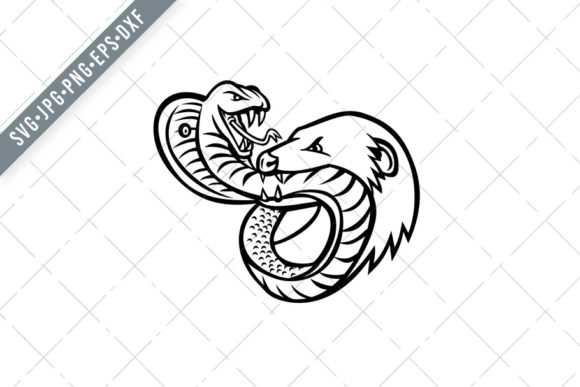
At its core, this is a downloadable bundle of digital files centered on one illustration: a king cobra and a mongoose facing off, biting and striking at each other, rendered in black and white with no background. The style is deliberately retro, with bold lines, crosshatching, and a hand-drawn feel that suits both print and digital applications. The set includes five file formats: SVG, PNG at 300 dpi (minimum 10 inches), DXF, EPS, and JPG. Each format serves a different workflow, and the inclusion of all five removes the guesswork for users who move between cutting machines, design software, and print platforms.
The illustration itself is the centerpiece. It is not a simplified icon or a clip-art silhouette. It is a detailed, dramatic scene with the cobra reared back, hood flared, and the mongoose lunging in. The front-facing viewpoint gives the image a confrontational, symmetrical quality that works well for centered layouts on apparel, posters, and cards. The black-and-white treatment ensures it prints cleanly on colored surfaces and can be resized without losing punch.
Key Characteristics and Purpose
The set is built around utility, not decoration. Every file type exists to solve a specific production problem. The SVG vector file, for example, is designed for use with Silhouette Studio Cameo, Cricut, and other cutting machines. If you make custom T-shirts, decals, or stencils, this is the format that lets you scale the design without pixelation and cut precisely. The EPS file serves a similar role for professional vector editors like Adobe Illustrator and CorelDRAW. The DXF file extends compatibility to CAD and drafting software, which is less common in graphic asset packs but genuinely helpful for users who work with laser cutters or CNC routers.
The PNG file is specified at 300 dpi with a minimum size of 10 inches. That matters. A 10-inch PNG at 300 dpi gives you a raster file with enough resolution for high-quality prints on mugs, wall art, and greeting cards. It also means you can scale down significantly without losing detail. The JPG provides a flattened, universally readable version for quick previews, mockups, or web use. The inclusion of a high-resolution PNG and a vector SVG together covers both raster and vector workflows, which is the most practical combination for a diverse audience.
Strengths in Real-World Use
When evaluating a graphic asset, consistency and reliability matter as much as aesthetics. The black-and-white retro style here is consistent across all formats. The line work remains crisp whether you open the SVG in a cutting software or the EPS in a vector editor. The isolation of the background means you can place the illustration on any color substrate, from a white mug to a dark T-shirt, without awkward halos or leftover background patches.
The practical value becomes clear when you actually use it for a project. Suppose you are designing a T-shirt for a martial arts event or a wildlife-themed merchandise line. The confrontation between cobra and mongoose is inherently dramatic, and the retro style gives it a timeless look that avoids trendy, dated aesthetics. That longevity is important for small business owners who cannot afford to redesign inventory every season. A design like this works for event posters, gym branding, or even editorial illustrations in niche magazines without feeling forced.
Usability extends to the cutting machine crowd. SVG files for Cricut and Silhouette often fail when they contain overly complex paths or poor node structure. This set handles that well. The paths are clean, the line weights are consistent, and the design does not rely on tiny details that will break during weeding or scaling. For anyone who has struggled with a vector file that looked great on screen but cut poorly, this is a meaningful improvement.
Who Benefits Most and in Which Situations
Freelance designers and small print shops will find the file variety immediately useful. Having SVG, EPS, and DXF in one download means you can take a job from client concept to final cut without format conversion. Apparel decorators who use heat presses or screen printing will appreciate the high-contrast, scalable vector that works on both light and dark garments when paired with the right transfer material.
Event planners and party hosts can use the design for reptile-themed events, survival-themed parties, or natural history celebrations. The black-and-white retro look suits invitations, banners, and cake toppers without requiring color matching or expensive printing. Educators and wildlife educators who need clear, dramatic visuals for handouts or displays will find the vector files easy to resize for posters or worksheets.
Marketers and content creators who produce wildlife, survival, or confrontation-themed content can use the illustration as a social media graphic, a book cover element, or a podcast thumbnail background. The isolated background means it composites easily into photographs or textured backdrops without extra masking work.
Scrapbooking and card-making hobbyists will find the high-resolution PNG and JPG versions suitable for printed elements. At 300 dpi and 10 inches, you can print at a reasonable size for a scrapbook page or greeting card front without seeing individual pixels. The retro black-and-white style also pairs well with patterned paper, washi tape, and other analog craft supplies.
Practical Considerations and Limitations
No asset is perfect for every use case, and this set has boundaries worth noting. The design is front-facing and symmetrical, which limits how you can crop or reposition it for certain layouts. If you need a side-profile or action-shot composition, this specific illustration may not fit. The black-and-white treatment is intentional, but it means the asset does not include color variants or layered color separations. If your project demands full-color photorealism or a delicate watercolor look, this is not the right choice.
The retro style, while a strength for many projects, may not suit ultra-modern or minimalist branding. The crosshatching and line detail evoke a specific era. If your brand voice is clean, sans-serif, and flat-color, this illustration might feel out of place. That is not a flaw in the asset itself, but it is a consideration when evaluating fit.
File size and resolution details matter. The PNG at 10 inches and 300 dpi is adequate for most small-format prints, but for large banners or movie-poster-sized prints, you will want to use the SVG or EPS vector formats to retain sharpness. The JPG version, while convenient, will have compression artifacts if stretched too far, so rely on the PNG or vector files for final output.
Long-Term Value and Flexibility
Because the asset comes in five file formats and follows a vector-first approach, its useful life extends well beyond a single project. You can use the SVG for a T-shirt design this month, then repurpose the EPS for a website header next quarter, and later use the DXF for a laser-engraved sign. The retro style does not age quickly, which matters for creators who build a library of reusable assets rather than chasing every trend.
For anyone who runs a print-on-demand store, a small craft business, or a content channel that regularly produces wildlife or confrontation imagery, this set becomes a reliable tool rather than a one-off purchase. The ability to scale, recolor (in vector software), and output to multiple mediums makes it more flexible than a simple JPEG download or a limited-format bundle.
Final Observations on Fit and Use
The King Cobra Snake and Mongoose Fighting set is a focused, well-structured design asset for adults who produce physical or digital products. It does not try to be everything to everyone. It targets users who need a dramatic, clean, retro illustration in formats that actually work with professional and hobbyist tools. If you cut vinyl, print mugs, design cards, or build wildlife-themed content, this set saves time and reduces format friction. If you need photorealism, color options, or a softer style, it is worth looking elsewhere. For the audience it serves, it delivers consistent quality, practical file support, and a distinctive visual that holds its own across print and digital applications.